Pages

Showing posts with label photos. Show all posts

Gardening A,B,C

When you have something that dominates your life, you tend to take a lot of photos of it.  That is especially true of me and gardening.  Recently I collected my photos through the years and in organizing them I put them into folders according to plant types as well as a few other designations.  The computer brings up the files in alphabetical order, so I thought I would go through them with you that way as well.

A


Starting off the A category is a lovely yearly favorite of mine - Allyssum.  Its dainty little flowers create a sweet smelling carpet.  It definitely wants things to be cool though.  Once the heat gets going little Allyssum will gradually just seem to vaporize.  First go the flowers and then the plant just shrinks back into nothing.  I have had better luck with it in pots rather than the garden bed.


One of the fabled, ever-bearing Amaryllis.  Since these are given to me from someone who forces the bulbs each year, I am always pleasantly surprised to see what blooms they will have.  I have no idea what this ones pedigree is, but it likes to bloom several times a year.


This is Angelonia which I put into the garden for the first time last year.  It managed to make it through August and then the two low twenties freezes we had last winter.  So not only does it have these masses of orchid like bloom clusters, but it is hardy as well.  My kind of plant.

B


This little guy is Barcopa.  I tried him last year and at first things were great and it grew and bloomed very happily.  Then it just died.  So, it has entered into the category of plants I have killed. 


Ah Basil.  A true gardeners friend in that it will grow very well with little effort.  I love it for its aromatic leaves as well as for eating.  Unfortunately it is another plant that finds hot weather offensive.


Here is the bloom of another plant I tried last year for the first time.  This is Bee Balm or Bergamot.  It also survived punishing heat and icy cold which puts it into the category of plants I have not yet killed.


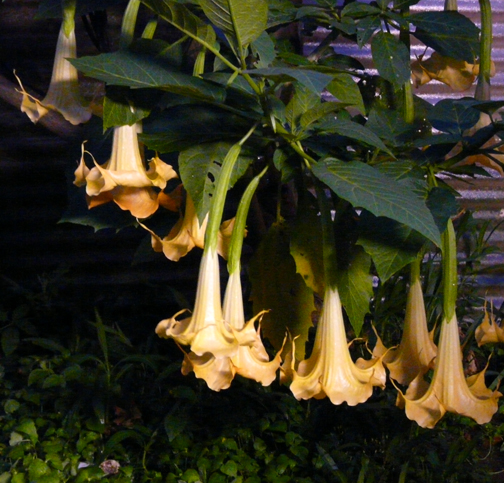
This is Brugmansia also known as Angel Trumpet.  It is a tree like bush that will produce hundreds of these trumpet shaped blooms.  They hang almost a foot in length and give off a heavenly scent at sundown.  To see one of these at their peak of blooming is amazing.  Your mind does not want to believe a plant like this can exist.  The bonus is that they  are very easy to grow from cuttings and even though the winter is tough on them they will come back from the roots.  Their problem is that they like it shady and wilt in the heat.


This is the bloom of Buddleia or Butterfly Bush.  I had high hopes for this plant because of its great blooms and because it was touted as growing into a tall mass which I wanted to use to shade some tall ginger.   It was one of those I tried last year who just up and died.  Too bad.


This is Bulbine.  This is the view of its stalk atop which are a mass of these yellow flowers in a cluster.  This one has been surviving well and I was surprised because its leaves make you think it is a succulent that cannot survive intense cold.  Apparently it is much hardier than it looks because it just shook off the cold and has come back rowdier than ever.

C


I have a thing for Caladiums, but I also cannot get in rhythm with them.  Due to our overly wet winters, the bulbs seldom are able to survive more than one season.  They like it in the shade and they don't like intense heat.  Since they are planted as a bulb I am never sure exactly when to put them in to maximize their incredible leaves.


This was the hardest of the plant pictures to choose from since I assigned myself the limit of only one picture per plant group.  Cannas are one of my most prized plants.  This variety has such great leaves that I thought this view was better than the blooms.


This is Cosmos and I like them because they will bloom and bloom and bloom.  Right now the bed I have them in is being slowly overtaken by the Scented Geraniums I put in this year, but this one valiant Cosmos is fighting back.


I had this plant for years before I ever knew what it was.  It was given to me from a defunct greenhouse.  I liked it for its huge curling strap like leaves and its trumpet shaped blooms that arrive several to a stalk.  This it turns out is Crinum.  There are many different varieties but I have no idea which one this is. 

That is enough of the plant alphabet for now...

Weeds - part 1


Sometimes it is the unexpected that gives us what we didn't know we were missing. This can definitely be the case when it comes to gardening. Most of the time a gardener sees a 'weed' as anything they did not put into the garden themselves. Weeds for the most part are unwelcome, but if we just relax a little bit we can discover that weeds are truly fabulous in their own right.

The following is a short list of some plants that sprang up in our garden with no assistance from us. We have no idea where they came from and for the most part welcome them in as part of our landscape. Sometimes they can be a little tiresome since they are typically very vigorous in both their growth and spread, but we find that with a little pulling here or there we can be very weed tolerant.

Late winter and Spring are a great time to meet many of these volunteers as they are often the first things that come up after the bleakness of the winter months have worn thin.

Henbit
lamium amplexicaule

Henbit is one of my favorite weeds.  It comes up early each spring and I like the way its leaves make a circle around the stalk.  It has little purple flowers and overall it is dainty and unassuming.  It is actually considered an edible salad green. They say to harvest the young shoots and leaves in the spring. I have considered doing this, but aside from munching on a leaf or two I have never had a henbit salad.

Velcro weed 
galium aparine

It starts off very tame looking but very soon will smoother just about anything with its wild and abundant growth. Velcro weed is very easy to pull up though so more of a mild nuisance. It becomes much more trouble if I let it get to its seed bearing stage because those little seeds will cling to the dogs fur and create mats. It too is considered an edible green and you are supposed to steam it before eating. A good idea because it isn't called Velcro weed for nothing. The leaves, stems and seeds are all covered with fine, stiff hairs and they cling to everything. Supposedly this plant was the inspiration for the fastener Velcro. Aside from eating its stems and leaves, they also say you can use the seeds as a coffee substitute. I have never eaten this plant, so I can't tell you what it tastes like. I figure if it was spectacular as a steamed green or coffee substitute it would be commercially grown.

Marsh marigold
Caltha palustris

I really like this plant and try to keep it in at least one area until it forms its seeds. The blooms are not much to look at being rather small, but I like the fleshy leaves and spiky seed pods. It forms fairly large clumps. Don't eat this one! It is toxic unless you cook it and cook it and cook it again, according to my wild edible plant guide. I figure anything that stays toxic through two cookings is not something I ever want in my mouth.

Elderberry

I like it for its pretty flowers, its purple berries and the fact that it grows tall enough to be good shade for some of my shade loving plants. I know that people do things like dip the flowers in batter and fry them, but I figure if you want to eat fried batter that badly, you might as well just eat a donut. People also dry the fruit and use it in pies and I think they make wine out of the berries. Like many plants though you don't want to eat its leaves, stems or roots. I am not tempted at all because it gives off a weird odor.

Snailseed 
Cocculus carolinea

It took me a while to find out what this vine was. It looks somewhat like a vine called Greenbriar, but Snailseed is less woody than Greenbriar and also it produces a lot of berries that birds like to eat. I do not like this vine because it grows about a foot a day and will choke out other plants. Before I found out its real name we called it the Sewer vine because my husband first encountered it growing over someones outhouse. If it would just grow on my fences I would like it better.


Trumpet vine 
Campsis radicans.


This is a vine we tolerate more than others due to its beautiful and prolific blooms.  Trumpet vine can be very invasive, but it does pull out by the roots fairly easily when it is young.  We have to watch out because it comes up everywhere.


It likes to grow up buildings and trees. We had a long standing vine in our front yard that grew up a tall Chinese tallow tree. The vine was so prolific that its flower masses were all the way up the forty feet of this tree. A whole flock of hummingbirds chased each other around that tree all season long. Unfortunately hurricane Ike put an end to that tree. We still have masses of the Trumpet vine growing along our fences and buildings. It even has a very attractive immature vine.


Turk's cap 
Malvaviscus arboreus var. Drummondii


This is another favorite of mine.  Turk's cap is a relative of the hibiscus plants but seems to prefer the shade.  Along with trumpet vine it is also quite attractive to hummingbirds.

Dollar Weed or Pennywort  
Hydrocotyle spp.


It gets its name from the half dollar sized round leaves it bears.  I hear commercials all the time talking about herbicides to help people control their Dollar weed problem. It is one of the easiest plants to pull up, but it does have a lot of runners. I like it because it acts like a living mulch and keeps the soil from drying out.

Papyrus 
Cyperus papyrus


It will form large stands that can grow about six feet high. Papyrus can be useful as a fence block, but it also sprouts readily from its many seeds. Easy to pull up when young. I guess if things ever got really tough I could learn to make paper from it. Some types of papyrus are edible. I have no idea if this one is or not.

Elephant ears 
 Colocasia


I am not sure if we ever actually deliberately put any of these bulbs in our garden. Elephant Ears sprout up in various locations at will. I try to corral them into one area. If they get enough water and we don't have a winter freeze they will grow quite large.

Four O'clocks 
Mirabilis jalapa


This is the most fragrant of all our weeds.  I know they are an introduced species but we never put them in our yard. They are a bit of a bother sometimes as you can almost never get the roots. The stems are easy to break off, so I can control them that way. They seem to be mostly a problem when we are digging garden beds as they form these huge root knots that get in the way of the shovel.


Wow, that's a lot of weeds so far and there are more to go but this is enough of the weeds for one post.

Garden Awards - Spring 2011


Well now that spring has ended, maybe not officially, but since we have had several days in a row of 100 plus degrees of temperature what the calendar might say is moot.  Spring is done - that ship has sailed so long ago you can't even see it anymore on the horizon.  Now all that is left is the memories and I thought it might be interesting to chronicle this years 'Best of Spring'.

Still going in spite of the drought

In spite of months of steady drought there was some great competition in the Vegetable Garden segment of the Best of Spring and I just want to give a hand to all of the contestants in all categories.  Great job of enduring the scant rainfall and still producing some record crops.

From upper left, clockwise:  Big Beef, Early Girl, Black Krim and Zebra Stripe
Under the Tomato Category we had four strong contestants including Big Beef, Early Girl, Zebra Stripe and Black Krim.  You all did a great job despite a serious case of creeping late blight but as you know there can be only one winner and that award goes to Big Beef for the most awesome production of large sized fruits, virtually no blossom end rot and continued production even as the weather has started to warm up.  Second place was a tough call with Zebra Stripe producing a large number of medium sized fruits and Black Krim producing a moderate number of large sized fruits.  It was a narrow margin but I have to hand it to the Black Krim who not only is continuing to produce but also has avoided more fruit rot and late blight.  Congratulations!

Big Beef for the Win!!!
Under the Cucumber Category we had three contestants including Straight Eight, Burpless Hybrid and Burpless.  For the second year in a row it was a landslide by Burpless.  You win in consistent production, large sized fruits with few seeds and most importantly a resistance to powdery mildew.


Burpless cucumber

Under the Onion Category we have two contestants, Red and Yellow who started off life in the grocery section as 'Pearl Onions'.  Having cast that lowly designation behind you both of you have excelled in production and hardiness, sneering at the low twenties weather of late winter.  So it is a tie for first place.

Yellow and Red Onions

The Pepper Category had several old favorites, Gypsy and Tam Jalapeno (mild) and some new hopefuls, Ancho, Cubanelle and Marconi.  First fruit goes to the Cubanelle but it and the Marconi suffered some early season interference from the Zebra Stripe tomato, so unfortunately their productivity was diminished.  However, there is a clear outstanding winner this year and it is the Ancho who has consistently produces large numbers medium sized dark green fruit and currently is covered with more than a dozen more developing fruit.  Second in this category goes to Tam Jalapeno who may pull ahead in the summer division of the games by sheer tenacity of production.


Ancho Pepper

Upcoming Hopefuls Category.  We are keeping our eyes on our summer contenders of Eggplant, Bush and Pole beans, Okra and Sweet Potatoes as well as Golden Yukon Potatoes.  The Clemson Spineless Okra has already been producing an ever increasing crop daily and we have already enjoyed several batches from the bush and pole beans.  We look forward to your continued productivity.  All eyes are on the Eggplants who are almost ready to present their first fruits.  We expect great things from you.  The Golden Yukon and Sweet Potatoes are new to the contest this year and we have no idea what to expect.  Who knows if we will even know when to harvest them, so this could be some exciting developments.

Clemson Spineless Okra

Eggplant
We are also nervously watching the canteloupes and wondering what more will befall those poor vines who have already suffered powdery mildew and then leaf burn on two occasions from our attempts to control powdery mildew.  In spite of this there is renewed vigor in the vines and there are two well formed fruit and a few others that seem to be developing.  Stay tuned - this could turn into a best of or a worst of experience.

Rogue Amaryllis follow no rules.
Now stepping away from the Vegetables let's take a look at the Ornamental Category.  There is a definite clear victory of blooming that must be awarded to the rogue group of Amaryllis.  These hardy bulbs stood up against bulb bias and have bloomed multiple times in the last six months.  Way to defy Amaryllis lore!

From top left, clockwise:  Cosmos, Viola, Scented Geranium and Scaveola
For the general Ornamental Category we had several contestants this year including Cosmos, Viola, Scaveola and Scented Geraniums.  The Viola were early winners but languished in late spring.  The clear winner due to voracious growth and toleration of the lack of rain goes to the Scented Geraniums.  You smell great, you look great and you are determined to take over your garden bed.  That's the kind of pluck we look for in an ornamental.  Good Job.


Heavenly Scented Geranium
No Awards would be complete without Honorable Mentions.  Best Volunteer goes to the Cherry Tomatoes.  You started life in the backwaters of the compost piles and have gone on to delight both Dog and Humans with highly productive lives.  We look forward to seeing you again next year as well.  We also want to give a shout out to the compost pile without whom the rest of the garden would be a shadow of its glorious self.  Thanks for your continued support.

Volunteer Cherry Tomatoes
Unsung Hero - Compost

Finally we wanted to give a nod to a little guy that has a category all to himself.  Introducing the Baby Anole Lizard.  Already he has done well for himself by staying in the dog free part of the garden which shows good marks for intelligence.  He wins the award for cutest wildlife.

Baby Anole Lizard

Garden Photos - part 1


I just found a file with a bunch of pictures from April when the garden was looking so fresh and happy so I thought I would share them.  I know I tend to complain about gardening a bit sometimes (also known as whining and moaning) so I thought I would show that sometimes it is all worth it.  This is a part one because I have heaps and gobs of photos that I will eventually subject you to, but for now this is the garden as it was in April.

The foreground in this view is one of our original garden beds, now devoted mostly to ornamental plants and flowers.  This is mostly due to it harboring a very determined number of snails and slugs who have shown a tremendous resilience to all organic solutions.  We have tried snail bait, copper strips, ceder granules and egg shells and it hasn't even slowed them down.  We tried a beer bait lure that is supposed to entice them into drowning themselves and I think they just threw a party.  So now we don't put vegetable plants here because somehow it is less aggravating to us for them to eat the ornamentals - that way at least they are not competing for our food supply.

The middle ground to the right is another one of our original garden beds and it is hosting the cucumber patch this year.  The middle ground to the left is one of our many water stations, this one in the form of a bird bath surrounded by shrimp plant.  In the background you can see the cedar fence and part of the seven garden beds we created this year.

 Here is a closer view of the birdbath and behind that you can see the tomatoes plants when they were still a reasonable size and I was all enthused about staking and trellising them.

Here are the tomato bushes up close.  There are three of them and they used to have actual space between them.  I was valiantly trying to make them be good neighbors but even this early in the season they were proving very resistant to anything that controlled their exuberant growth.  At this point they are about 4 feet tall.  If you look to the lower left of the picture you can see a green tomato, one of the many these plants produced.

Here is a closeup of one of the tomato blossoms. 

This is a photo of one of the first new beds we created this year.  It has been growing since the winter and survived through two low twenties freezes.  In the background is Swiss Chard and in front are some onions.

Here is a ground level wildlife watering stations backed by purple canna and a blooming white crinum on the left.

Here is a wild Border Collie making use of the watering station.  We originally had the bird bath for the birds and this lower watering station for whatever creatures didn't want to use the birdbath.  So this could be considered a lizard bath or something - maybe a toad pool.  Trudy however considers herself the owner of all things that hold water.

So, we gave Trudy her own Border Collie bath.  She can't get enough of it.  One of her favorite things to do is stick her face into it and blow bubbles through her nose.  Sometimes I stock her bath with baby carrots so she has something to dive for.

This anole lizard probably wants to visit the watering station since at this point in the year it had been months since there was any appreciable rain.  He is however a wary lizard which will serve him well.

This lizard on the other hand is not as wary.
He is interested in perpetuating his species and is doing the equivalent of flashing his mighty biceps to any female lizards in the area.

If he is not careful, this female will be the last thing he sees.  I have rescued several lizards from Trudy so far this year.  She does not outright kill them, but carries them around in her mouth and puts them down to play with them.  When the lizard tries to run she puts her paw on top of it.  This 'play' allows me a little time to intercede on the lizards behalf and I put these stressed out little guys into the dog proof area of the garden.  I imagine in time the natural selection process will make two distinctly different subsets of lizards in our yard.  In the dog area will be the fast and wary lizards and in the dog proof area will be the slower but smarter lizards who have chosen to remain in the sanctuary.

Here is Trudy looking slightly guilty about catching lizards.  Or maybe she is off to catch one and is seeing if I am paying attention to her.

Here is Trudy pleading to have her lizard back again.  Or maybe she wants more baby carrots in her pool.

 This is a close up of one of the many cucumber vines.  I always seem to go through some sort of gardening amnesia each year and think that in order for us to have enough cucumbers I need to plant a whole bunch of them.  I believe I put in about a dozen plants this year.

This is the female bloom of the cucumber and if it is fertilized...

...it will look like this in about two days.  It has been a great year for cucumbers and practically all the female flowers got fertilized which resulted in a harvest of more than a dozen cucumbers per day when it was at its peak.  It is not possible for two grown humans and two dogs to eat a dozen cucumbers per day and live meaningful lives.  We therefore became the cucumber cornucopia to our friends and family.

Now lest you think we have only vegetable plants in the garden, here is a close up view of the ornamental snail and slug bed along with the only dog in our yard that does not make daily deposits.  I think you are required by law to have garden art of some sort and our beds are infested with it.  The yellow and orange cosmos in the background have been under assault by the snail/slug coalition as well as from the scented geraniums just visible along the right edge of the picture.  I know next to nothing about scented geraniums except that they are the bullies of this garden bed and are trampling all the other plants.  Every time I go to trim them back the scented geraniums entice me with their heavenly smells and I end up leaving them alone.  I told the cosmos they should work on smelling better if they want more room.

Here are some amaryllis that do not obey the laws of this type of bulb.  These are rogue plants - the masters of their fate.  They were forced into bloom last year and then given to me when the blooms died.  I planted them, knowing, according to amaryllis law, they would not bloom for at least another year.  They had other ideas and  bloomed that same year just months after I planted them.  I thought - okay - now they won't bloom again for at least a year.  But here they are, blooming in the spring.  They put all my other amaryllis to shame.  And don't think I don't mention it to the others - those slackers.  The other bulbs just grumble something about these blooming guys being law breakers.

Not everything in the garden is planted in the ground.  Here are a few of the pots of ornamental plants with an orange calibrachoa in the front and nasturtiums and viola in the back.

Here is a closer view of the nasturtiums.  Technically they are edible, but far too pretty to eat.

Here is a closeup of the viola, one of my favorite varieties.  I forget what they are really called - I call them the Monkey faced violas - they look like they belong in the Wizard of Oz.

Here is another of the ornamentals - a scaevola, which I first tried last year.  It is supposedly a perennial but right now just an annual for me until I figure out how to stop killing it.

Here is the best ornamental in our garden, the rare blooming Westhighland White Terrier.  Rare because he is actually rather white in this photo instead of his preferred dirt caked hue.  It isn't all his fault as Trudy is constantly slobbering all over him, but Lewey also likes to roll in 'things' - things being whatever loathsome substance he can find up to and including dead things, bird poop and the Holy Grail of loathsomeness: possum poop.  This is also a rare photo in that Lewey is looking at the camera.  Whenever you try to take a picture of him he usually turns away in disgust. 

That's enough about the garden for now...